← All selected work

INDEPENDENT EDUCATIONAL PRODUCT

The Thinking Box

An educational product studio where learners investigate an idea, interpret evidence and make their own decisions, with optional AI professional support.

Local app implementedLearner validation pending
Explore The Thinking Box
Role
Independent product lead across the learning proposition, experience design, AI integration, technical delivery and founder usability testing.
Maturity boundary
A founder-operated local R&D build, not a deployed classroom service. Think is implemented; Model and the later stages, the final product demo and presentation remain in development. The User/Admin switch is local role rehearsal, not authenticated access. Learner comprehension, educational outcomes and classroom readiness are not yet validated.

CURRENT LOCAL APPLICATION

From an observation to a brief you can explain.

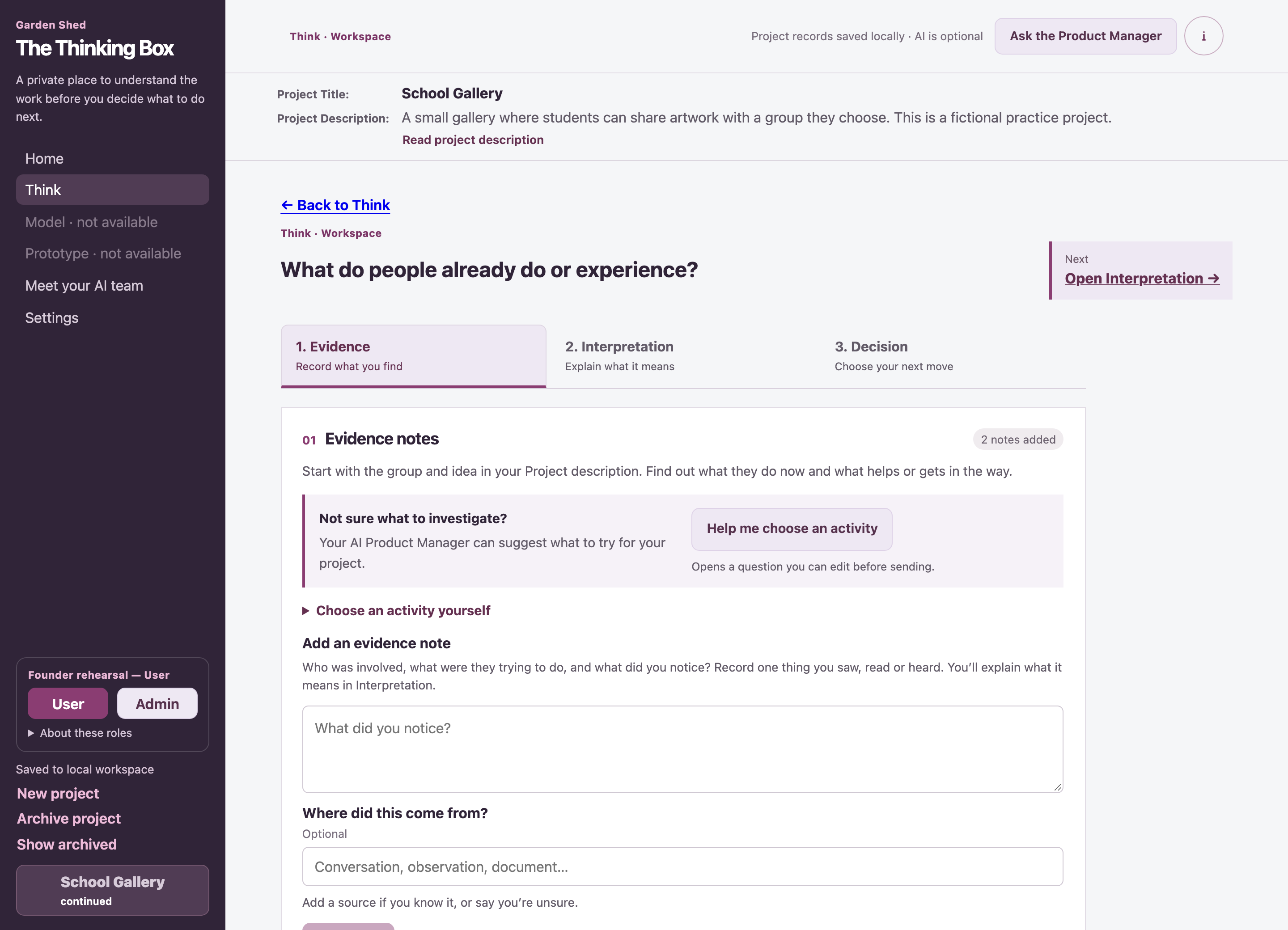
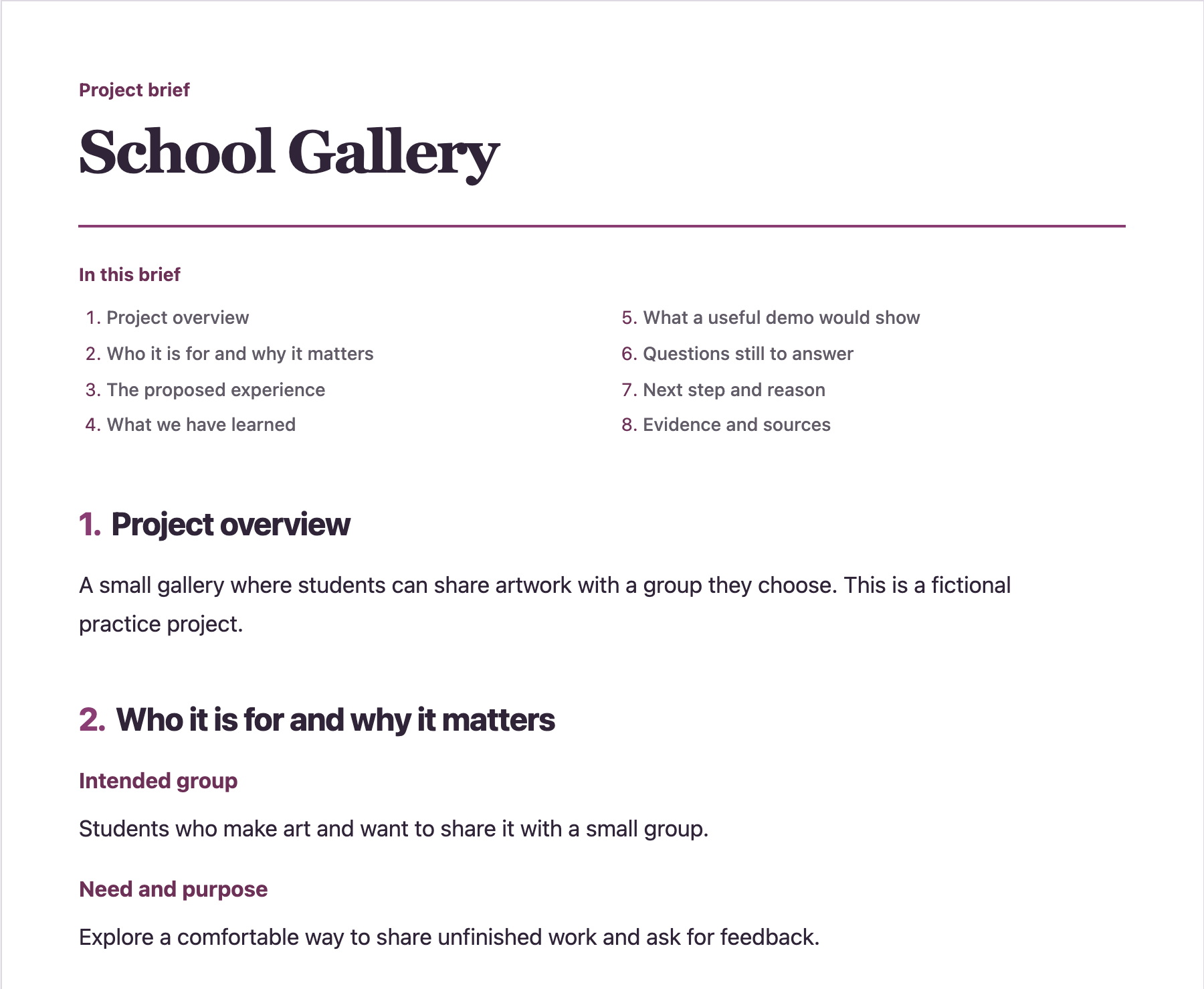
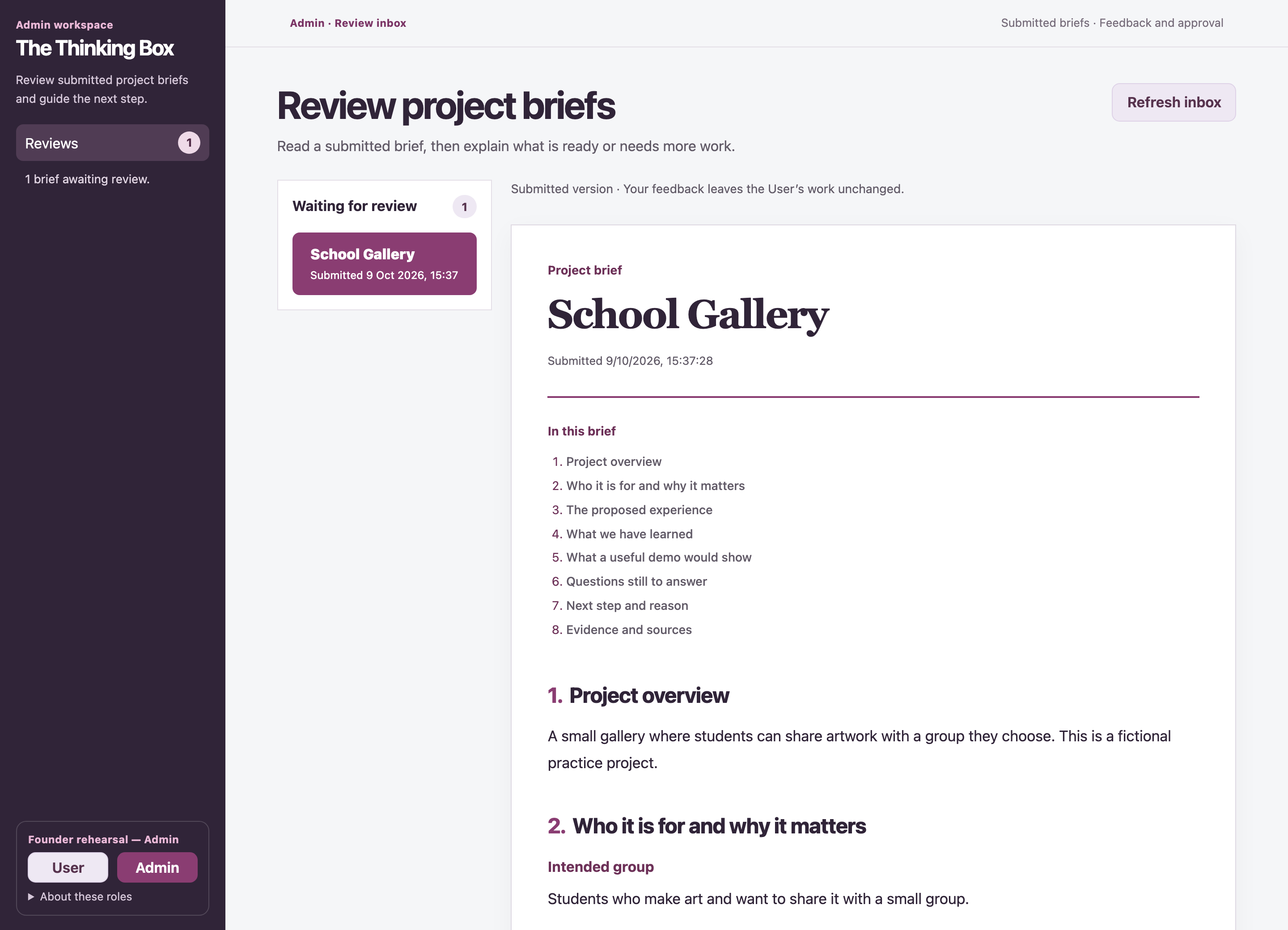
Actual app captures · 9 October 2026 · Fictional practice contentThese screens show the working local Think journey, project brief and founder Admin review. School Gallery is a fictional practice project. The screenshots establish the interface's current state, not learner outcomes or a hosted classroom service; AI was disabled for capture.

CONTEXT

AI can help someone produce software before they understand who it is for, what evidence supports it or why it works as it does. The Thinking Box asks how creating a product can also develop the learner's judgement, vocabulary and ability to explain their choices.

MY CONTRIBUTION

I developed the earlier Human-Led Agentic Product Studio into an educational product direction and led a working local implementation. The work connects evidence, human interpretation, decisions, recoverable project records, optional AI professionals and a reviewable brief.

WHAT IS TRUE NOW

As of 9 October 2026, the local app supports the Think journey from project context to evidence, interpretation, a decision, a complete project brief and founder Admin review. Saved histories, draft recovery, Markdown exports and two optional AI paths are implemented.

  • Learner authorship
  • Evidence stays with the work
  • Human judgement

PURPOSE & AUDIENCE

Build the product. Build the builder.

The Thinking Box is the current educational focus of the earlier Human-Led Agentic Product Studio. Its intended audience centres Irish Transition Year learners who may be new to product development, with a facilitator available and professional roles introduced through the work.

The intended outputs are a controlled product demo and a learner-owned presentation explaining the idea, evidence, choices and remaining uncertainty. Meaningful choices should change behaviour, information or rules. A polished result alone cannot demonstrate that the learner understands it.

Programme duration, group ownership, facilitator responsibilities and assessment remain open. The current focus is a coherent learning experience before beta, rather than a promised school programme.

IMPLEMENTED JOURNEY

Keep observation, interpretation and decision distinct.

The learner gives an idea context, investigates one question and records what they saw, read or heard. Watch, Try, Read and Ask activities provide a way in without requiring AI. A separately saved interpretation explains what the notes might mean and what remains unknown.

Continue, Revise, Park and Stop are deliberate human choices, each with a reason. A current interpretation and recorded evidence are required before a decision. These checks establish completion of the workflow; they do not prove demand, evidence quality or learning.

THE FIRST SUBSTANTIAL ARTEFACT

A proposal that keeps its evidence attached.

After Continue, the learner develops the intended audience, need and proposed experience. Saved context, interpretation and decision carry into a readable project brief with contents, numbered sections and the complete original evidence and sources.

The document preserves the learner's words and paragraph breaks. Previewing, submitting and reviewing use the same structure. Each submission is a fixed version: later edits cannot rewrite the evidence an earlier review was based on.

Admin can request changes or approve progression, with feedback required for either. Approval records a review outcome; it does not unlock a Model stage that has not been built.

AI & HUMAN AUTHORITY

Professional support, with authorship kept visible.

Two optional AI paths are connected. A Product Manager explains concepts, suggests activities and drafts idea notes when asked. A Product Researcher challenges a saved interpretation with possible overstatements, alternatives and questions tied to the supplied evidence.

Sending a request and accepting proposed idea notes are explicit actions. Accepted notes remain labelled AI-assisted planning material; they do not become evidence, the learner's interpretation, a decision or Admin approval. Other professional roles remain planned.

The Product Manager receives saved project context, but structured brief fields and Admin feedback are not yet included. That missing connection is a defined next increment, not a capability being claimed today.

TECHNICAL DELIVERY

Make the work recoverable as it changes.

The local application combines a React and TypeScript interface, a Node service and SQLite records. Revision checks protect against silently overwriting newer work; project histories, draft recovery, Markdown reports and validated backup-and-restore support continuity.

AI credentials stay on the server, while Product Manager conversation state also persists at the provider. This is not a zero-retention system. The build uses fictional, non-sensitive practice material and a self-selected User/Admin rehearsal switch.

Hosted learner use still requires real authentication, protected Admin assignment, project-level access controls, appropriate data handling and operational recovery. The present implementation remains local.

DIRECTION & NEXT EVIDENCE

Connect the brief to the rest of the journey.

The intended sequence is Think, Model, Prototype, Learn, Decide, Architect, Build and Protect. Only Think is implemented. Its question-level decision is distinct from the later Decide stage; the demo and presentation are not yet available end to end.

The next work is to close the current brief and review loop, then carry one School Gallery journey into Model and a bounded prototype. School Swap and School Mixtapes are reference concepts for later challenges, not finished applications.

Founder testing and scoped technical checks provide useful development evidence. Whether learners understand the work, make better decisions and can explain a product they have helped create still needs independent observation.

EVIDENCE & BOUNDARIES

  • The 9 October 2026 project status report records implemented local capabilities, scoped automated and browser checks, and a historical live-provider integration check. Those checks do not establish representative teaching quality or classroom readiness.
  • Founder observations have shaped the guidance, conversation behaviour, decision support, brief and review experience. Independent learner research and the latest founder walkthrough results remain pending.
  • The screenshots are actual local application captures using fictional School Gallery records, with AI disabled for capture. They contain no student or private founder records.
  • Executable Product Development Framework v1.1.0 remains a separately released teaching and development framework. Its release is not an application release.

WHAT I CARRY FORWARD

A product the learner can explain, and choices they can own.

The working Think journey now turns observations into a recoverable, reviewable proposal. The next challenge is carrying that authorship through a controlled demo and presentation, then testing the educational assumptions with learners.

Explore all selected work