← All selected work

INDEPENDENT PRODUCT

Mira

A private creative-writing studio for capturing fragments, noticing the threads between them and shaping them into stories—with optional AI kept reviewable and in service of the writer's own words.

Product implementedPrivate beta in development
Role
Independent product lead and builder across product framing, interaction design, creative-AI boundaries, architecture and implementation.
Maturity boundary
The current private PWA, authentication, offline support, Edge Functions and security and migration checks are implemented. The complete source-traceable fragment-to-project workflow and first credible private beta remain programme goals; no adoption or creative-outcome claim is made.

CURRENT INTERFACE + PRODUCT STORY

What exists now—and what Mira is becoming.

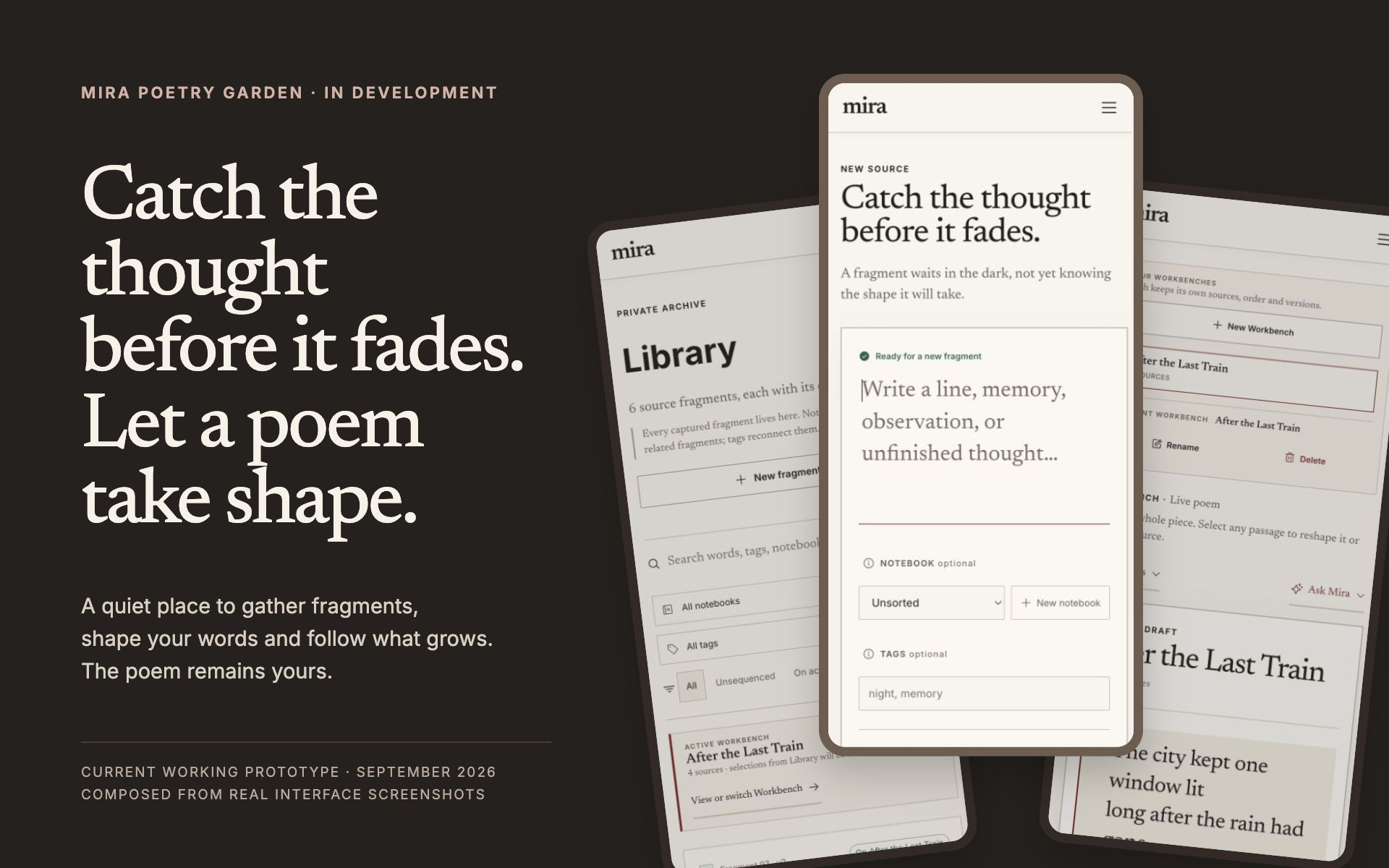
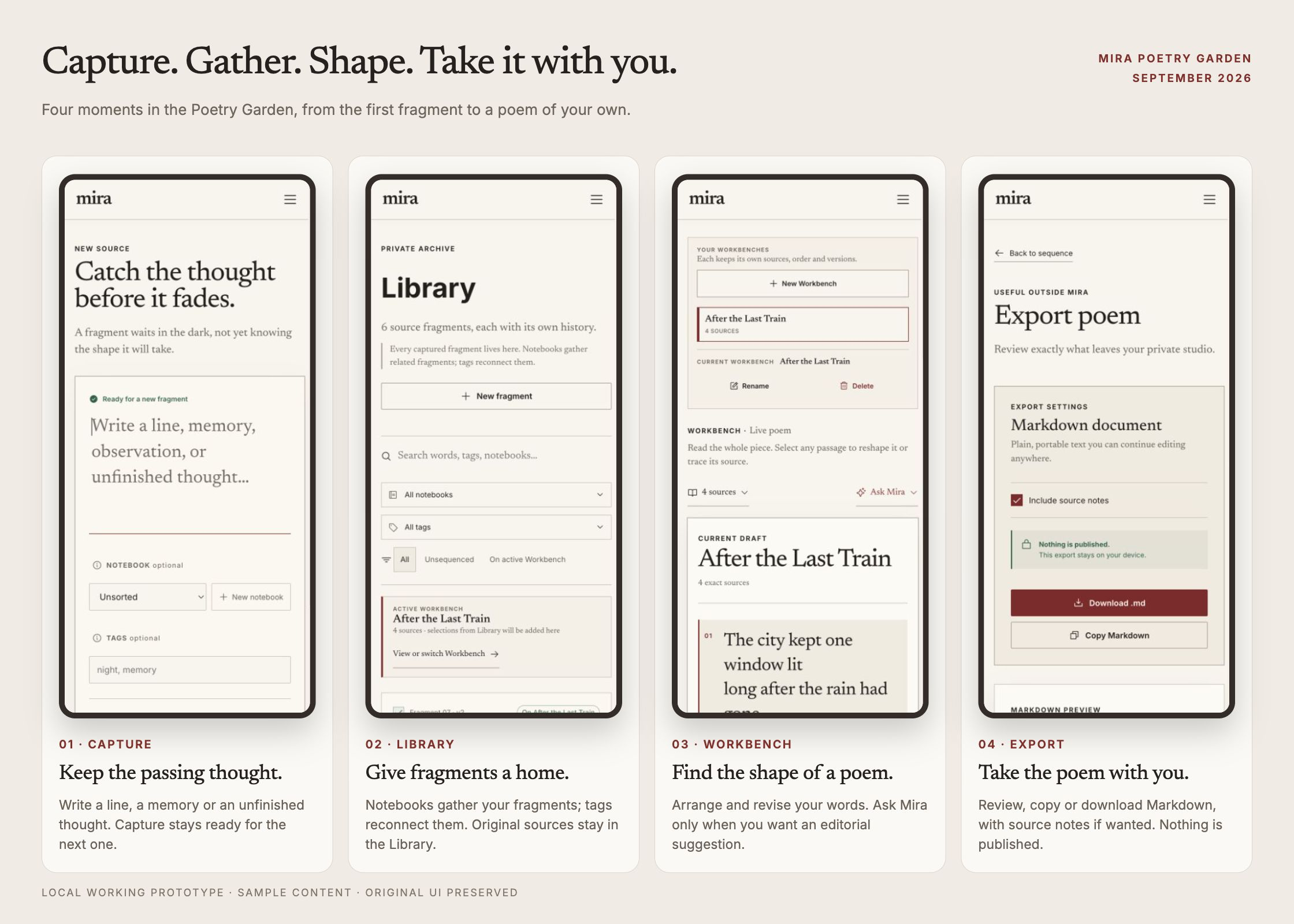
In development · August 2026The first two visuals reflect Mira's current in-development interface. The final product-story composite combines one current app capture and the current quiet 3×3 framework with two beta-direction concepts. Those concept panels are not shipping UI or proof that the complete source-linked workflow exists.

CONTEXT

Writers often capture fragments before they know what those fragments belong to. The product problem is how to preserve that material, help the writer notice what is forming and keep any AI contribution subordinate to the writer's source material and judgement.

MY CONTRIBUTION

I designed and built a private PWA spanning capture, thought-type suggestions, creative exploration and pattern views, with Supabase authentication, offline support and server-side AI workflows.

WHAT IS TRUE NOW

Implemented product surfaces now exist across capture, explore and pattern workflows. Mira remains in active development toward a credible private beta; retention, creative usefulness and authorship outcomes have not been validated with external users.

  • Capture without friction
  • Source material stays central
  • Authorship remains human

CONTEXT & PROBLEM

Fragments arrive before projects have names.

A line, observation or image can matter before the writer understands why. Conventional notes preserve the text but rarely help someone notice the themes, tensions and forms beginning to connect across it.

Mira starts with private capture, then helps the writer return to their own material with more context rather than replacing it with generated work.

PRODUCT MODEL

Capture first. Notice the shape later.

The experience moves through capture, notice, explore and patterns. A quiet framework organises recurring modes of thought without presenting the categories as a clinical assessment.

  • Write or speak before the fragment disappears.
  • Accept, reject or reconsider plain-language suggestions.
  • Explore recurring material, themes and creative threads over time.

AI & AUTHORSHIP

Help the writer notice; never take the work.

AI can suggest a thought type and surface possible themes, voices, tensions or literary forms. The writer retains the source material, decides what feels true and chooses what becomes part of the work.

The intended role is closer to a mirror or thoughtful collaborator than a ghostwriter.

IMPLEMENTATION

The current product is implemented, not imagined.

Mira is built as a Next.js PWA with Supabase authentication, offline support and OpenAI-backed workflows executed through server-side functions. The hosted experience is private and public signup remains disabled.

Those choices create a credible product surface while keeping identity, source material and provider credentials out of public client code.

VALIDATION BOUNDARY

Working software is not evidence of creative value.

Implementation shows that the interaction and technical system can exist. It does not show that writers will return, recover useful material, trust the patterns or feel that authorship remains intact.

The next gate is observed use in a bounded private beta with those behavioural and qualitative questions stated in advance.

EVIDENCE & BOUNDARIES

  • The private implementation repository evidences the working application baseline, authentication flow, offline behaviour, Supabase integration and server-side AI functions.
  • The first two media items show implemented product surfaces. The final product-story composite distinguishes a current app capture and product framework from two beta-direction concepts.
  • Public evidence is limited to sanitised descriptions and supplied visuals. No external retention, creative-output or user-impact claim is made.

WHAT I CARRY FORWARD

The right AI role is closer to a mirror than a ghostwriter.

The next gate is to observe whether writers return, recover useful fragments and trust the surfaced patterns while still recognising the work as their own.

Explore all selected work