A QUIET PLACE. SOMETHING GROWING.
There’s a poem
in the things
you keep.
A line on the way home. A memory that won’t leave. Gather the fragments that find you, and give them room to become a poem.
Find your place in MiraPublic release still growing · Waitlist opening soon
FOUR FRAGMENTS. A DIFFERENT FEELING.
After the rain
The rain has left its silver on the gate.
An empty chair keeps yesterday in place.
The garden grows around what I can’t say.
A little light stays longer than it should.
A tiny taste of Mira. Try moving the feeling around.
Arrangement 1 of 24. The rain has left its silver on the gate. An empty chair keeps yesterday in place. The garden grows around what I can’t say. A little light stays longer than it should.
Your words, held onto.
Your pace, always.
Your poem, in the making.
FROM A FRAGMENT TO A FEELING
You don’t have to start
with a poem.
Start with something you noticed. Mira is being made for the space between a passing thought and a piece of writing you want to keep.
- 01 / CAPTURE
Catch the thought.
A phrase, an image, an unfinished line. Save it before you need to know what it means.
- 02 / GATHER
Let it find company.
Return to your Library. Follow a theme, a memory or a connection across the things you’ve kept.
- 03 / SHAPE
See what takes root.
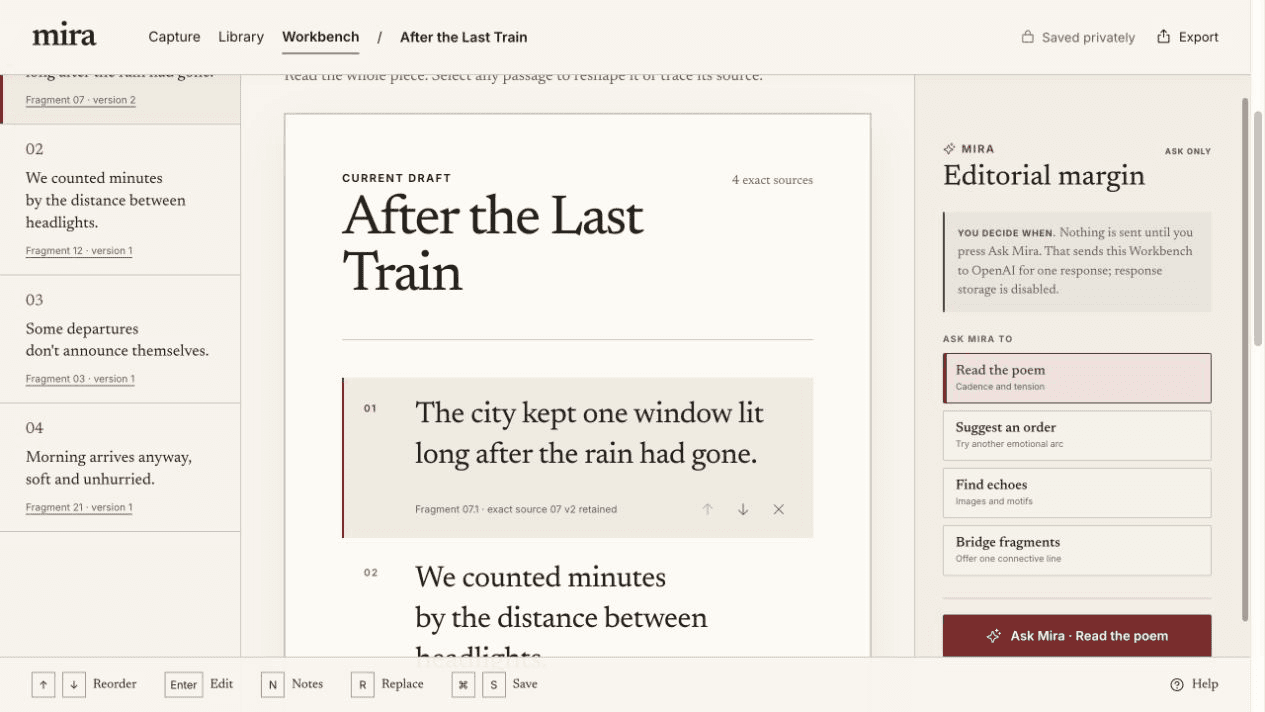
Bring fragments to a Workbench. Move them, make space, try a different order. Keep the originals.
- 04 / TAKE WITH YOU
Leave with your words.
Export your draft as Markdown. Continue writing wherever the next line finds you.
A SECOND PAIR OF EYES. NOT A SECOND AUTHOR.
A little help,
only when you ask.
Ask Mira to notice an echo, suggest another order, review a draft or offer a line between fragments.
Every suggestion is yours to consider, change or leave behind. You can make the whole journey without asking AI anything.
What happens when I ask Mira?THE GATE ISN’T OPEN JUST YET
The garden is growing.
Come in when it opens.
For practiced poets, occasional scribblers and anyone with a line they can’t quite let go of. We’re preparing a waitlist for news of Mira’s public opening. Please check back here soon.
A launch waitlist, not an app account. No release date or pricing has been announced.
Waitlist sign-up isn’t open yet. No email is collected here yet.
BEFORE YOU COME IN
A few things to know.
Do I need to be a poet?
No. Mira starts with fragments, not finished work. An observation, a sentence, a memory or an image in words is enough to begin.
Is Mira available to use now?
Not publicly yet. There is a working prototype, being shaped through real writing and iteration. The waitlist is for news of public access—not an instant invitation or a paid reservation.
Does AI write the poem for me?
The writing stays yours. In the current prototype, you choose when to ask for assistance and whether to use it. Asking Mira sends the relevant Workbench writing to OpenAI for that response. Nothing needs to be sent to AI to capture, arrange or export your work. This page’s sample rearrangement makes no AI request.
What happens to my original fragments?
Preserving them is central to Mira. The prototype keeps the original source separate from your working draft and retains revisions, so trying a new direction doesn’t mean giving up where you started.
Who’s tending the garden?
Mira is an independent project by Brendan Flynn, built around the pleasure of gathering words and finding what they might become. Read the story behind Mira.