← All selected work

INDEPENDENT PRODUCT DISCOVERY

Foreground

A build-gated exploration of helping young people leave passive feeds for self-chosen real-world action, without creating another engagement machine.

Discovery foundationBuild gated
Role
Independent product lead across product discovery, framing, experience design, trust and safety, requirements and delivery planning.
Maturity boundary
Vision, journeys, trust-and-safety requirements, delivery gates, a static pitch and concept prototype material exist. No durable product, participant evidence, minor-facing research approval, validated coaching or safeguarding model, or active data collection is claimed.

EARLY CONCEPT

The idea, made visible without pretending it is built.

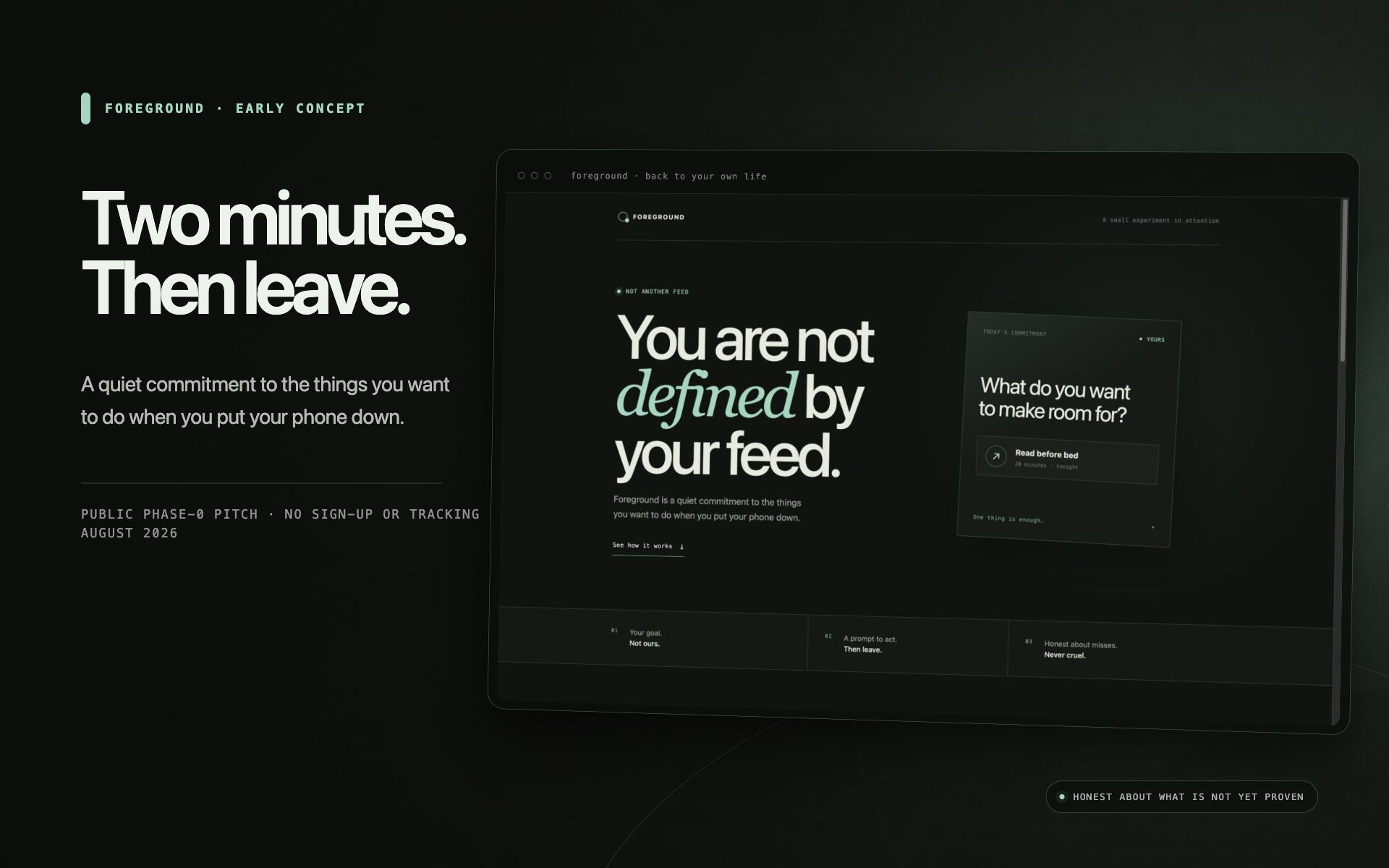
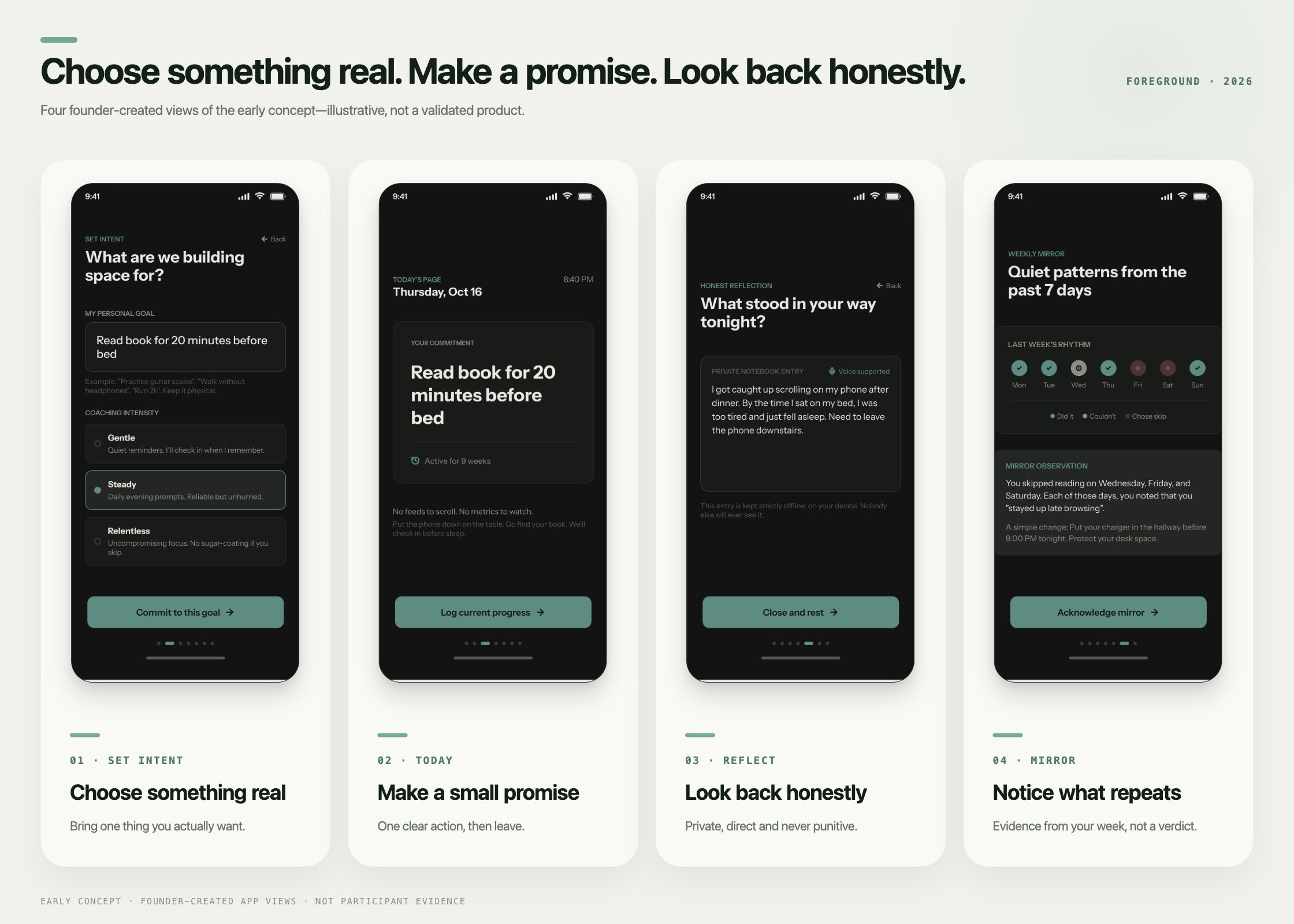
Phase 0 · Early concept · August 2026The first image records an earlier public-facing Phase-0 pitch. The repository is now private. Both images are concept material I created, not a working application, public sign-up, participant evidence or a validated safeguarding model.

CONTEXT

The originating hypothesis is that young people need a quiet space to choose something that matters, act away from the phone and reflect honestly without entering another attention-maximising feed.

MY CONTRIBUTION

I translated the original product intent into a structured discovery foundation spanning the problem, audience hypotheses, journeys, requirements, experience mechanics, trust and safety, architecture assumptions, delivery gates and concept views I created to make the hypothesis tangible.

WHAT IS TRUE NOW

A detailed product requirements and discovery pack exists. No application code or participant evidence exists, and the central behavioural, audience and safeguarding assumptions have not yet been tested with intended users.

  • Real-world action over engagement
  • Private by default
  • Evidence before build

CONTEXT & PROBLEM

Design for leaving, not staying.

Foreground begins with an unusual success condition for a digital product: brief use followed by meaningful action away from the phone.

The intended experience is a small private space where a young person can choose something they want, make a manageable commitment and look back honestly without entering another feed.

PRODUCT THESIS

Two minutes, then back to your own life.

The working thesis connects a chosen real-world action, a light-touch commitment and non-punitive reflection. The product should never turn missed intentions into shame or optimise for time spent inside the app.

That principle is firm; mechanics such as goal limits, notification cadence, coaching tone, streaks and rewards remain open to evidence.

DISCOVERY SYSTEM

Separate conviction from product evidence.

The discovery pack keeps my originating assumptions, interpretation, open decisions and recommendations distinct so that a coherent document cannot make an untested belief look settled.

  • Preserve the emotional reason for the product without freezing the first solution.
  • Make audience, behaviour and experience assumptions explicit.
  • Tie later delivery to named evidence and decision gates.

TRUST & SAFETY

Treat an inner life as sensitive product data.

The proposed trust model treats personal reflection as sensitive data. It prioritises clear consent, data minimisation, age-appropriate safeguarding and careful escalation, while keeping AI support bounded in tone and purpose.

Those boundaries are requirements to investigate and validate; no implemented safety system is claimed.

DELIVERY GATE

A complete specification does not earn a build.

The concept views make the intended rhythm discussable, but visual coherence is not participant evidence.

The next gate is research with intended users and age-appropriate safeguarding expertise to test the problem, language, trust expectations and smallest credible experience before application development begins.

EVIDENCE & BOUNDARIES

  • The private discovery repository evidences the vision, audience hypotheses, journeys, requirements, trust-and-safety work, technical assumptions and gated delivery plan.
  • The supplied screens are illustrative concepts I created and retained as discovery input. They are not application captures or evidence from intended users.
  • The intended age range and proposed behavioural benefit remain hypotheses. No adoption, behaviour-change, safeguarding or wellbeing outcome is claimed.

WHAT I CARRY FORWARD

Restraint is part of product leadership.

The immediate job is not to turn the concept screens into code. It is to learn whether intended users recognise the problem, which mechanics help without shaming and whether the trust model can support a credible next decision.

Explore all selected work